
So we are all going to be driving “Electric Vehicles” in the not so distant future.
The days of the dirty diesel and polluting petrol cars are numbered. As the oil is running out and the temperature of the Earth is rising due to increasing CO² emissions bellowing out the back of our century old technology vehicles, the future has never needed to be more “NOW” than……………well, now to be exact.
Goodbye V8 and the glorious sound of petrol exploding like Tom Jones and Barry White arguing with a Thunder Storm!


EV (Electric Vehicles) are really quite cool. They are the equivalent to the motor industry that the Iphone was to the mobile market when it was introduced. (Cell phones to those who have Presidents). They are a revolution in the way we will travel. As electric is being used in a much more advanced way in every aspect of our lives, the humble motor car has now joined the party. Simply by using your smart phone you can heat your house, turn on lights, monitor cameras, operate any electrical component through a network. We accept this as quite normal these days and now,….. now you can even control your car as it too becomes part of the network.
OK, “What’s the time scale?” I hear you ask. “When can I get my hands on one and how much will it cost?”
Transport Ministers and Environment Ministers will be pushing hard on this subject. All world leaders will be desperate to achieve total EV transport in the next 15 years or so. 2025 will be mentioned, but this is not realistic. 2030 will demand around a 75% transition and 2035 will be what many Eco protesters will call humanities last chance saloon. If we haven’t changed our ways in 10 to15 years time, we may be facing extinction!!! EV cars are the epitome, the “Poster Boy” of the change we need to make in order to survive!

What’s not to love? They’re quiet, rapidly quick, cool designs with very few moving parts,(as opposed to an engine which has over a thousand mechanical components).
They’re packed with Hi-Tech, will be able to drive themselves and they are clean! Clean, Clean, Clean!!!
Or are they?
See, everyone thinks that electric cars are the future. As it happens, electric cars are the past.
Well over 100 years ago we had electric cars, they’re nothing new.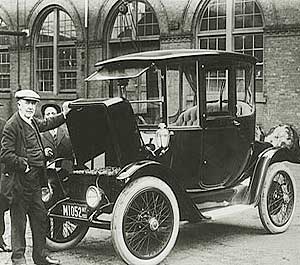
The car pictured above is a Porsche.
NO!…..Not the black one, the white one above that you bleedin idiots!
With prices starting over £80’000! they’re only cool looking if you have a fair bit to spend, and being a Porsche most the extra’s will push it well over £100k.
But are they clean?
No, they’re not. Not clean, Not cool and no more Hi-Tech than an electric can opener. The electric can opener attempted to solve a problem that didn’t exist. With a manual can opener you have complete control but you work a bit harder. An electric can opener added an Alkaline battery (non recyclable, poisonous) into the equation. The “Ring Pull”, now that is a can in it’s most efficient form. Modern day Turbo charged petrol cars are cars in their most efficient form. If you were to drive a modern turbocharged petrol car through a polluted city like Los Angeles for example, the gases coming out of the exhaust pipes are cleaner than the air getting sucked in through the front grill. Technically, modern petrol cars would improve the air quality in built up area’s. That folks, is a fact!!
But what makes an Electric Vehicle not clean? Well that would be the plug!! Electricity is everywhere, but we have to excite it in order to harness it and use it. So to create it we need Power Stations. These come in three varieties. Gas Fired Power Stations, Coal Fired Power Stations and Nuclear.
Gas. This is heated up to boil water and create steam in a turbine. The steam is then used to power a second turbine creating electricity.
(By the way, I am being really basic here in my explaining as this blog is not about how a power station works but basics are required for understanding)
Coal. Operates the same way as Gas but Coal is burned to generate the heat that boils the water into steam.
Nuclear. Heat is generated by splitting the nucleus with a neutron creating energy. The energy boils the water and the steam is used to turn a turbine which creates electricity.
I’m guessing most of you can picture how gas and coal work? Gas is like boiling water on a gas hob and coal is like shovelling the black stuff into a steam train and voila, steam. That steam has a lot of energy and movement. Which turns a fan (turbine) and the fan creates electricity. Imagine a wind up torch. The handle is the fan (turbine), you are the steam (turning the handle), your stomach is the power station (fed by curry and beer not coal and gas) and the light coming out of the torch is electricity! Simple!!
What comes out the back end of you is where the problem lies! we’ll come back to that.
Nuclear is probably harder to picture………So here’s a picture.
All of which is perfectly safe until the Nuclear Power Plants themselves get old. They only live for about 40 to 50 years then the safety materials start to decay. Gets messy. Might kill a few things nearby. Say within a 50 mile radius, probably a lot more. Unless it explodes then it might give you radiation poisoning a couple of thousand miles away!! At least the effects only last a thousand years or so. No harm done. Who doesn’t love a 2 headed sheep due to radiation poisoning? Anyone? No? Just me then?
 “Baaaahhh.” “Two headed sheep have 2 bodies and 8 legs you moron”
“Shut Up Shaun you single use plastic not real or radioactive sheep!”
Anyway, back to point. Why does this make electric cars dirty. Because the plug you are using to charge your car is powered by one of these power stations. Coal burning creates CO² emissions, Gas causes the Greenhouse Effect and Nuclear is literally a “Ticking Time Bomb”. Ok it might not tick but it’s flippin dangerous.
Let me just answer one question before I get asked it. “No, Nuclear power itself is not dangerous. It doesn’t harm the planet and it is very stable and reliable!”
What makes it the worlds worst killer is the state of the plants themselves. A lot of, if not all of the UK’s Nuclear Plants are old. They were built in the 70’s and 80’s and over the years the care and attention regarding maintenance and day to day running has not been worthy of a fast food joint, let alone a NUCLEAR POWER STATION!!! According to some sources and official reports the checks needed and carried out have not met the standards required. This leaves nuclear power stations vulnerable to failure.

The other issue with nuclear, and it is a big one, is the waste. Basically most of it is buried underground in a Geological Disposal Facility.

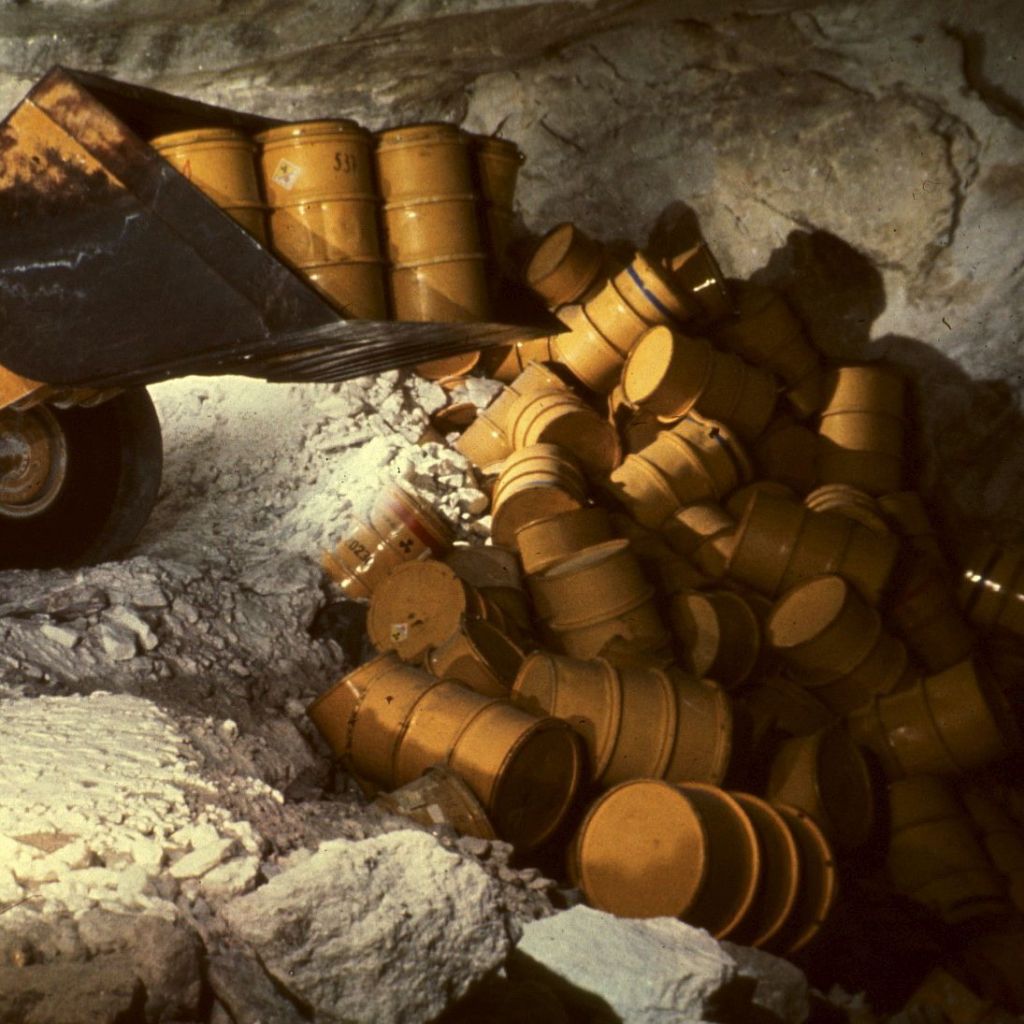
Right, let’s leave power stations there as we are talking about electric vehicles.
At the end of this blog I will add a report by Professor Derek Abbott who explains the current energy situation. He also gives details on the harmful wastes that are left.
Now obviously we had to mention energy as electric vehicles have to rely on “The Grid” to get their power. Fossil fuel cars seem to be more free. Yes you have to pull into a station and fill your car up, but this takes moments to do. Charging an electric vehicle can take hours for a full charge, and then you have to do it again in another couple of hours. Also, if you run out of petrol you just put a bit more in with that little plastic can and you’re good for another hundred miles or so. Run out of electric and you’re going home on the back of a recovery truck!! I’ve always wandered why no one has come up with an emergency battery pack that looks like a petrol can? It could charge when you are charging your vehicle via a lead in the boot and you just switch to reserve battery if you run out!
That was the revolutionary thing about cars, their Internal Combustion Engine. It gave people freedom to travel care free. Not worrying the whole time about battery levels if they come across a big hill. (Big hills use more energy, kills the batteries).
Most people are under the impression that you can only run a car on petrol or diesel? This is not the case. Engines can be adapted to run on many, many different fuel types.
You can run a diesel engine on sunflower oil which people have done!
Stanley Meyer created an engine that run on Water!!!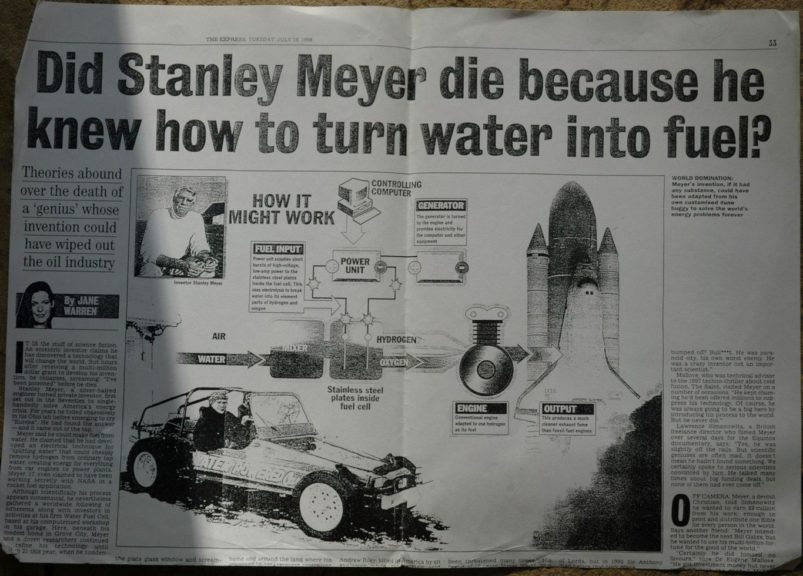
His death created quite a stir as he claimed to have been poisoned in a restaurant whilst out with his brother and two potential Belgian investors.
So what do we need if we are to convert everyone to electric vehicles?
Below, is a report by TNW which highlights the issues of infrastructure and dependence on local councils.
“Despite efforts to add EV charging points, RoadChef, one of the country’s top three motorway service station operators, isn’t able to move forward as planned.
Its EV charging point plans have largely been held up by local electricity grid operators (DNOs). Chairman Simon Turl says the local operators charge millions of pounds and take up three years to install the required infrastructure.
“It feels like our power network at times is not fit for purpose to serve this massive charging need that is coming,” Mr Turl told the FT.
“We can fund this, there is no cost to the state. But we can only make that provision as quickly as the DNOs can make it happen,” they added.
Welcome Break, another top three operator, tells a similar story saying it was quoted “tens of millions of pounds” to install a high-speed charging connection at just one of its sites.
Given the UK government’s intention to ban petrol and diesel cars by 2040, one would expect it to be a little more proactive at supporting those looking to install EV charging points.
National Grid, the organization that operates the UK‘s electricity network, has reportedly earmarked 54 locations in England and Wales where “ultra rapid” chargers could be built without having to build entirely new infrastructure. But it will come at a cost of up to £1 billion (ca. $1.3 billion) and won’t happen overnight.
The cost to install EV chargers will be highest in rural areas where they are perhaps needed most. That is if the UK is to hit its vehicle emission targets and encourage drivers to use EVs for longer journeys.
Even though battery technology is improving EV range, many still cite “range anxiety” as the main reason they haven’t bought a battery powered car. Better infrastructure is just one way to help allay such stresses of EV ownership.
If the UK is to meet its 2040 targets, it’s going to have to redress its approach to charging infrastructure, and fast.”
Another problem is the cost of buying. There are millions of people with cars worth less than 10 thousand pounds. Spending 30, 40, 50 thousand or more on an electric vehicle is not possible. To make things worse, those who can’t afford an EV are going to be punished for using their petrol/diesel car increasing their day to day costs through no fault of their own!
“When do you think most people will want to charge their car?”
“Erm, at night?” “Correctamundo! At Night!”
Wind or Solar power is nowhere near the performance of Nuclear so that’s out. Gas and Coal are as welcome to an eco warrior as sirloin steak is to a vegan, dipped in beef dripping with a pork sausage on top. (the meal…not the vegan).
Malcolm McCulloch, head of Oxford University’s Energy and Power group, says that if car charging could be done intelligently, then only 20 additional Megawatts of power would be needed- that’s the equivalent output a reasonably sized offshore wind farm. If not, then the capacity of the National Grid would need another 20 Gigawatts, which is double the amount of energy currently generated by all the UK’s nuclear power stations.
There’s over 32 million cars registered in the UK and we don’t have the capacity to charge them all if they were electric, what happens when the commercial market goes electric???
The biggest problem facing lorries and vans is weight. It’s one thing travelling 150 miles on a full charge in your 40kw eco box, but how do you move 30 tonnes efficiently? The batteries needed would create even more weight and the range would be next to useless. Yes the batteries will get more advanced in their capabilities with advancing technology, and this will take time as more is learnt how to use the energy with greater intelligence. But imagine the amount of commercial vehicles that would need charging every night!! There wont be enough electric left to make a cuppa during the ad breaks, and that really will be an emergency! Also, the industry of gathering the materials needed for the batteries wouldn’t cope with demand.
I do find it coincidental that just as Extinction Rebellion and the likes tell us we are all going to die in 15 or twenty years if we don’t act now, the motor industry suddenly explodes with all these ready to go electric vehicles. I’m starting to think that whoever kicked this trend off maybe behind all the climate emergency propaganda that has put the fear of extinction into the people!
That’ll be Elon Musk then and his Tesla boxes! This is the guy who builds all the rockets for NASA now, bet they don’t run on electricity!! This is the guy who wants to dig tunnels under Los Angeles and apparently sent one of his Tesla roadsters into space on a mission to Mars or something crazy. For fun he created and sold FLAME THROWERS!!! I kid you not. This guy burns more fossil fuel than a thousand families will in their whole life!!! Man, we are a dumb society.
Do you know what goes into the batteries for electric vehicles?
There’s a complex chemistry of metals – cobalt, lithium, nickel and more.
The demand for copper due to electric vehicles is expected to
increase by 1,700 kilotons by 2027. The mining of Nickel is more damaging to the environment than if everybody was driving around in Lamborghini’s.
Any excuse to post a Lamborghini picture. A Diablo SE30 in case you were wondering. Look at it! I don’t think any electric car will ever stir such emotions as a V12 slice of automotive yummyness.
Anyway…
Cobalt is a mineral used in batteries to make them more stable. The more cobalt you have the more stable the battery, (stops it catching on fire). This also means less energy density which reduces the range of the battery and that is a problem. Most of the world’s cobalt comes from the Democratic Republic of the Congo (DRC), which as an industry exploits it’s workers through poor working conditions, is corrupt when dealing with authorities and usually rely on child labour so you can drive around in quiet luxury.

Digging for Blue Gold, Cobalt.
Add to this the mining of metals and minerals and the transportation of all these components around the world, and the amount of diesel lorries, trains and boats used to distribute these elements far outweighs how much “Damage” you could do to the environment driving your car in a couple of hundred years.
If the process is more damaging than the answer, then we’ve got the answer wrong!!
There are so many sources for all this information. So many sites. Government sites, Ofgem sites, Energy sites, Climate sites, and none of them have the same results. I have poured over hundreds of reports, graphs, studies, predictions. Picking out two the same is difficult. The amount of energy created, the amount of energy used. The public sector, the industry sector, all the numbers vary. There is no single figure that everyone agrees on. What everyone does seem to agree on, is this country is not equipped to switch from fossil fuel energy or nuclear energy to power our transport needs. Even if we do have to constantly build nuclear power stations or keep drilling for gas or mining coal, the infrastructure required to transfer that energy to the people is more than a lifetime away. By then, we may have come to our senses and realise that the process to power the EV Revolution, is more damaging than the cars that freed us in the first place!
There is a long long way to go in our bid to be more efficient, more friendly to the environment, more responsible. The problem it seems is not the gas guzzling tyre burning great sounding fun machines we have spent over a hundred years finessing and improving. The real damage being done it would appear, is replacing one polluting issue…..with multiple polluting solutions.
Electric Avenue it would seem, is a bit of a cul-de-sac.
Below, is an overview of the current energy situation including a study and report by
Professor Derek Abbott of the University of Adelaide.
I have included this as I believe the electric vehicle craze is merely a spoke in the climate debate wheel, and we know that fear campaign will run out of steam!!
A major environmental concern related to nuclear power is the creation of radioactive wastes such as uranium mill tailings, spent (used) reactor fuel, and other radioactive wastes. These materials can remain radioactive and dangerous to human health for thousands of years.
Nuclear power emits more greenhouse gases per kilowatt hour than all renewables, including biomass (up to 41 grams per kilowatt hour), hydroelectric and solar (up to 13 grams per kilowatt hour), and wind (up to 10 grams per kilowatt hour). Reactors produce significantly less carbon dioxide than all fossil fuels.
Commercial energy generation produces the majority of nuclear waste in the U.S., which remains stored above ground near each of the 99 commercial nuclear reactors scattered around the country. Nuclear waste is stored in pools to cool for many years, and some is moved to above-ground concrete casks.
Nuclear power stations and coal-fired power stations usually provide ‘base load’ electricity – they are run all the time because they take the longest time to start up. Oil-fired and gas-fired power stations are often used to provide extra electricity at peak times, because they take the least time to start up.
The UK has 15 operational nuclear reactors at seven plants (14 advanced gas-cooled reactors (AGR) and one pressurised water reactor (PWR)), as well as nuclear reprocessing plants at Sellafield and the Tails Management Facility (TMF) operated by Urenco in Capenhurst.
Uranium abundance: At the current rate of uranium consumption with conventional reactors, the world supply of viable uranium, which is the most common nuclear fuel, will last for 80 years. Scaling consumption up to 15 TW, the viable uranium supply will last for less than 5 years.
A coal-fired power station or coal power plant is a thermal power station which burns coal to generate electricity. Coal-fired power stations generate over a third of the world’s electricity but cause hundreds of thousands of early deaths each year, mainly from air pollution.
More than 40% of global electricity is derived from coal
| Rank | Country | Coal Production (Millions of Tons) |
|---|---|---|
| 1 | China | 3,411 |
| 2 | India | 692 |
| 3 | United States | 661 |
| 4 | Australia | 493 |
| 5 | Indonesia | 434 |
| 6 | Russia | 385 |
| 7 | South Africa | 251 |
| 8 | Germany | 176 |
| 9 | Poland | 131 |
| 10 | Kazakhstan | 102 |
Derek Abbott, Professor of Electrical and Electronic Engineering at the University of Adelaide in Australia
As Abbott notes in his study, global power consumption today is about 15 terawatts (TW). Currently, the global nuclear power supply capacity is only 375 gigawatts (GW). In order to examine the large-scale limits of nuclear power, Abbott estimates that to supply 15 TW with nuclear only, we would need about 15,000 nuclear reactors. In his analysis, Abbott explores the consequences of building, operating, and decommissioning 15,000 reactors on the Earth, looking at factors such as the amount of land required, radioactive waste, accident rate, risk of proliferation into weapons, uranium abundance and extraction, and the exotic metals used to build the reactors themselves.
“A nuclear power station is resource-hungry and, apart from the fuel, uses many rare metals in its construction,” Abbott told PhysOrg.com. “The dream of a utopia where the world is powered off fission or fusion reactors is simply unattainable. Even a supply of as little as 1 TW stretches resources considerably.”
His findings, some of which are based on the results of previous studies, are summarized below.
- Land and location: One nuclear reactor plant requires about 20.5 km2 (7.9 mi2) of land to accommodate the nuclear power station itself, its exclusion zone, its enrichment plant, ore processing, and supporting infrastructure. Secondly, nuclear reactors need to be located near a massive body of coolant water, but away from dense population zones and natural disaster zones. Simply finding 15,000 locations on Earth that fulfill these requirements is extremely challenging.
- Lifetime: Every nuclear power station needs to be decommissioned after 40-60 years of operation due to neutron embrittlement – cracks that develop on the metal surfaces due to radiation. If nuclear stations need to be replaced every 50 years on average, then with 15,000 nuclear power stations, one station would need to be built and another decommissioned somewhere in the world every day. Currently, it takes 6-12 years to build a nuclear station, and up to 20 years to decommission one, making this rate of replacement unrealistic.
- Nuclear waste: Although nuclear technology has been around for 60 years, there is still no universally agreed mode of disposal. It’s uncertain whether burying the spent fuel and the spent reactor vessels (which are also highly radioactive) may cause radioactive leakage into groundwater or the environment via geological movement.
- Accident rate: To date, there have been 11 nuclear accidents at the level of a full or partial core-melt. These accidents are not the minor accidents that can be avoided with improved safety technology; they are rare events that are not even possible to model in a system as complex as a nuclear station, and arise from unforeseen pathways and unpredictable circumstances (such as the Fukushima accident). Considering that these 11 accidents occurred during a cumulated total of 14,000 reactor-years of nuclear operations, scaling up to 15,000 reactors would mean we would have a major accident somewhere in the world every month.
- Proliferation: The more nuclear power stations, the greater the likelihood that materials and expertise for making nuclear weapons may proliferate. Although reactors have proliferation resistance measures, maintaining accountability for 15,000 reactor sites worldwide would be nearly impossible.
- Uranium abundance: At the current rate of uranium consumption with conventional reactors, the world supply of viable uranium, which is the most common nuclear fuel, will last for 80 years. Scaling consumption up to 15 TW, the viable uranium supply will last for less than 5 years. (Viable uranium is the uranium that exists in a high enough ore concentration so that extracting the ore is economically justified.)
- Uranium extraction from seawater: Uranium is most often mined from the Earth’s crust, but it can also be extracted from seawater, which contains large quantities of uranium (3.3 ppb, or 4.6 trillion kg). Theoretically, that amount would last for 5,700 years using conventional reactors to supply 15 TW of power. (In fast breeder reactors, which extend the use of uranium by a factor of 60, the uranium could last for 300,000 years. However, Abbott argues that these reactors’ complexity and cost makes them uncompetitive.) Moreover, as uranium is extracted, the uranium concentration of seawater decreases, so that greater and greater quantities of water are needed to be processed in order to extract the same amount of uranium. Abbott calculates that the volume of seawater that would need to be processed would become economically impractical in much less than 30 years.
- Exotic metals: The nuclear containment vessel is made of a variety of exotic rare metals that control and contain the nuclear reaction: hafnium as a neutron absorber, beryllium as a neutron reflector, zirconium for cladding, and niobium to alloy steel and make it last 40-60 years against neutron embrittlement. Extracting these metals raises issues involving cost, sustainability, and environmental impact. In addition, these metals have many competing industrial uses; for example, hafnium is used in microchips and beryllium by the semiconductor industry. If a nuclear reactor is built every day, the global supply of these exotic metals needed to build nuclear containment vessels would quickly run down and create a mineral resource crisis. This is a new argument that Abbott puts on the table, which places resource limits on all future-generation nuclear reactors, whether they are fuelled by thorium or uranium .As Abbott notes, many of these same problems would plague fusion reactors in addition to fission reactors, even though commercial fusion is still likely a long way off .Of course, not many nuclear advocates are calling for a complete nuclear utopia, in which nuclear power supplies the entire world’s energy needs. But many nuclear advocates suggest that we should produce 1 TW of power from nuclear energy, which may be feasible, at least in the short term. However, if one divides Abbott’s figures by 15, one still finds that 1 TW is barely feasible. Therefore, Abbott argues that, if this technology cannot be fundamentally scaled further than 1 TW, perhaps the same investment would be better spent on a fully scalable technology. “Due to the cost, complexity, resource requirements, and tremendous problems that hang over nuclear power, our investment dollars would be more wisely placed elsewhere,” Abbott said. “Every dollar that goes into nuclear power is dollar that has been diverted from assisting the rapid uptake of a safe and scalable solution such as solar thermal. ”Solar thermal devices harness the Sun’s energy to produce heat that creates steam that turns a turbine to generate electricity. Solar thermal technology avoids many of the scalability problems facing nuclear technology. For instance, although a solar thermal farm requires a little more land area than the equivalent nuclear power infrastructure, it can be located in unused desert areas. It also uses safer, more abundant materials. Most importantly, solar thermal can be scaled to produce not just 15 TW, but hundreds of TW if it would ever be required. However, the biggest problem with solar thermal technology is cloudy days and night time. Abbott plans to investigate a number of storage solutions for this intermittency problem, which also plagues other renewable energy solutions such as wind power, in a future study. In the transition period, he suggests that the dual-use of natural gas with solar thermal farms is the pathway to building our future energy infrastructure.
- Thank you to each and all who have contributed to this blog. If I have missed referencing anyone for their work on this, please let me know and I will add full credibility where required.
Electric Vehicles and Hybrids can have a place in the world although the means for building them is still dangerous on many levels. Do they need to replace internal combustion engine vehicles i.e. petrol and diesel? No, not with cleaner engines and sustainable fuels entering the market.
i don’t like this term fossil fuels either. Oil is not a fossil fuel and gives such the wrong impression. Arguably coal is more of a fossil fuel and a necessity for the survival of electric cars.
I’m going to finish off telling you something that I probably mention in most of my blogs, rants and upcoming books. Do you want to know what the problem is? It’s not the environment even though you’ll constantly hear CO2 emissions being branded about as the ultimate argument. The atmosphere currently contains around 0.04% of CO2 and only about 2% of that 0.04% is created by the good old motor car.
As always, this is a money issue. There are countess ways in which we could all live in a free clean world but that takes away the power and control of the ruling elite who own the countries governments and ultimately own the people. Why do you think all the worlds leaders, the rich and the famous are all being chauffer driven in the back of V8’s and flown around the world in private jets and helicopters before relaxing on 200 foot yachts? Because it’s a sham! It’s another way of taxing the people and extracting more money out of the pockets of the people who’s incomes are stretched the most.
If you want to know where the root of all evil originates… follow the money!

 The Conspiracy Kitchen
Leave a comment